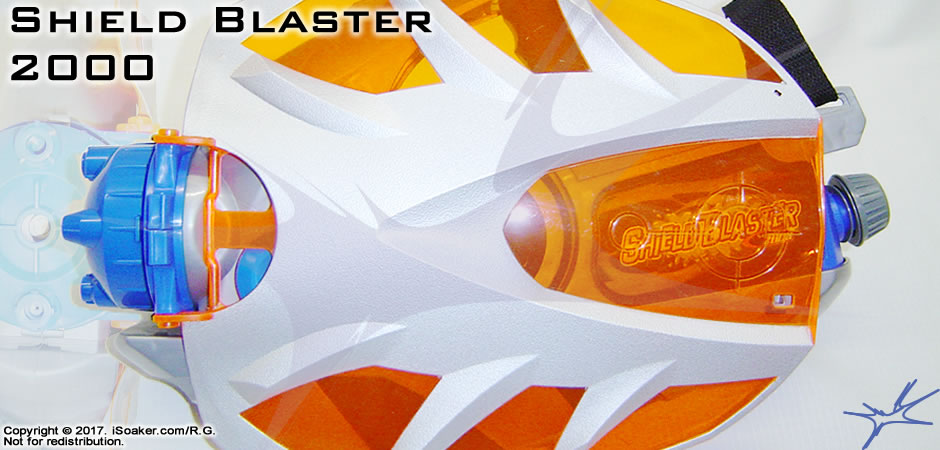
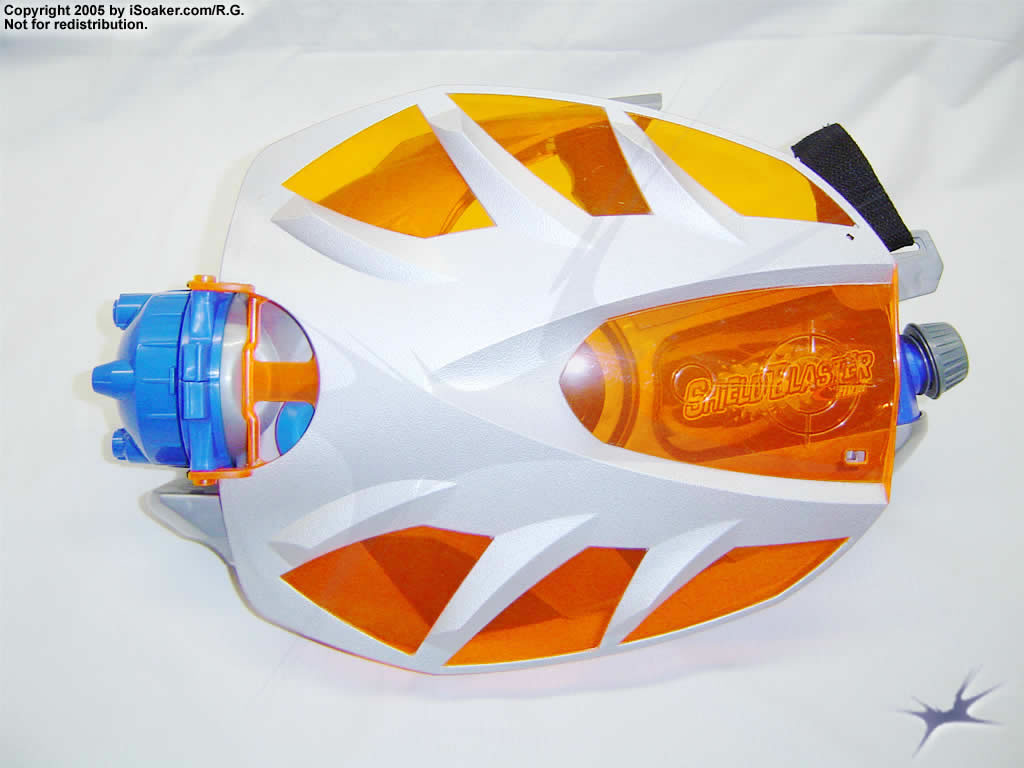
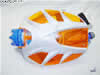
 The Shield Blaster 2000 is the mid-sized peristaltic-pump-based water blaster released in 2004 by Mattel Inc. Unlike most other types of water blasters on the market, the Shield Blaster series relies upon a crank-based system to push water from the reservoir and out the nozzle.
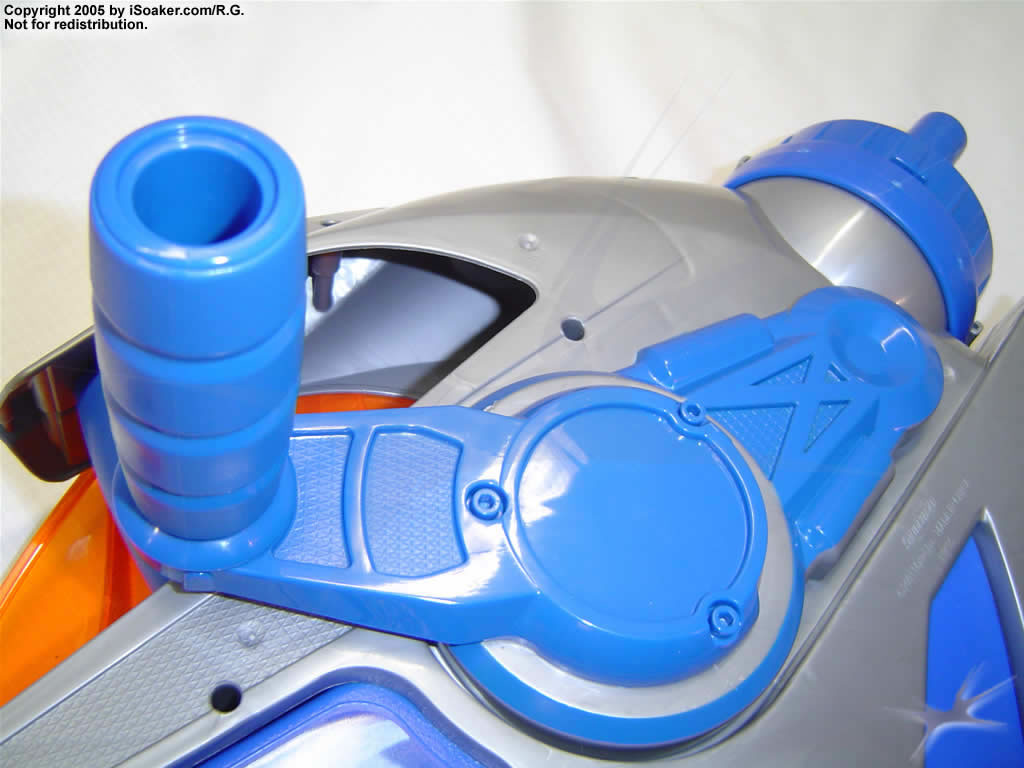
 The Shield Blaster 2000 comes in two different colour schemes. Out of the box, one must attach the crank to the body of the blaster prior to use. Afterwards, it's just a matter of filling the reservoir and turning the crank to begin blasting. Designed for being held by one's left hand and cranked using the right, the Shield Blaster 2000 is opposite other blasters which are typically held by one's right hand while pumped using the left. There is also a velcro strap which is meant to help secure the blaster to one's hand/arm. Admittedly, this configuration felt somewhat awkward. Switching hands is not an option. As well, since the blaster is strapped on, it makes it impossible to use additional blasters easily since one would need to release the strap and put the blaster down before one could make use of another blaster.
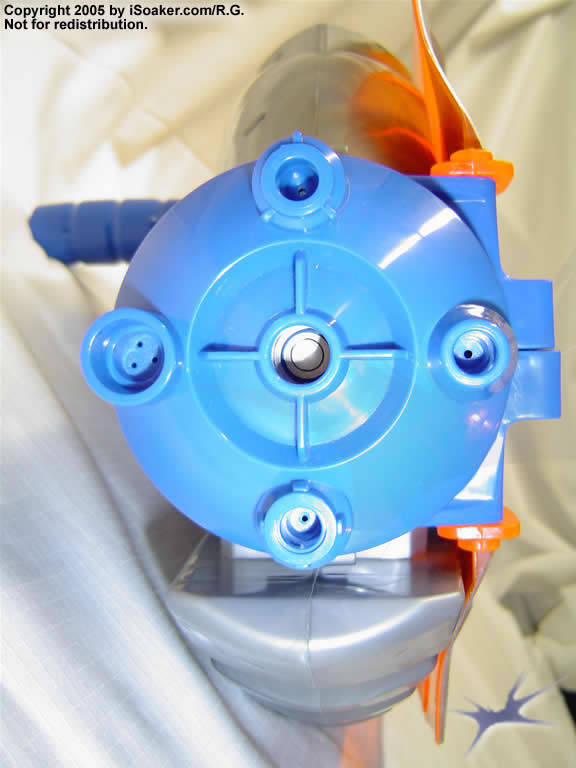
 The blaster, itself, features four different stream settings based on which position the nozzle selector is in. There are three different stream thickness settings and one triple-spreading stream setting. Pumping, though not difficult, made it more difficult to keep the stream held steady since one must be turning the crank for water to be flowing. As well, while no pre-pressurization is require in order for the Shield Blaster 2000 to shoot, the size and range of the streams are mediocre at best. One can achieve a slight improvement in range by cranking faster, but this also comes at the price of less control over the direction of the stream. Also, the fact that this blaster does not pressurize also means one always needs to be cranking in order to produce a stream.
Its name, however, arises due to the additional shield device that is attached to this blaster. The shield portion can be folded down if not desired or swung out and rotated about the barrel of the soaker in order to offer some protection from incoming streams. Usefulness is actual water battles is there, but the clip used to hold it down when not desired does not hold tightly. Combined with the awkward nature of the pump, it is questionable whether one will be able to make good use of the shield even though it is there.
In the end, the Shield Blaster 2000 has some potential, but does not pull through as well as it could have. Crank-based stream production could be useful, but the choice of hand mounts and small pump volumes means awkward pumping motions and overall lower output. While perhaps useful for base defence, it is not recommendable to confront users of soakers larger than an XP310 or Max-D6000.
Pros
No need to pressurize to shoot a stream of water. Built-in adjustable shield.
Cons
No strap. Awkward hand placement when pumping. Small nozzle settings and limited water capacity.
Submitted Review .:
By: Hydrogen31 (Posted 202609)
Shield Blaster 2000
The Shield Blaster 2000 is a medium-sized primary blaster that shares the same crank-based system as all other Shield Blasters, while also sharing many of their issues.
The main feature of this blaster lineup is the idea of having a shield integrated into the blaster, capable of blocking incoming enemy fire. For once, this blaster’s shield is actually able to do that, as it is big enough to block a decent amount of incoming enemy fire, actually giving a meaningful advantage in battle. Plus, contrary to the smaller models, the shield is rotatable, meaning you can position it to the left side, to the right side, or even on the upper part of the blaster. This means you can block shots from different angles depending on what position you are shooting from.
Another positive thing about this blaster, which is in common with all Shield Blasters, is its quite unique design and color choices, which I do like. I also do quite like the crank-based system and definitely prefer it to piston-based blasters, but I would not say it is better than air pressure blasters, and of course, nowhere near as good as the CPS blasters.
Performance: Now let's talk about the main negative part of this blaster, which is its water output and especially range. This could have actually been a very good blaster, just like the Shield Blaster 3000, if it wasn’t for the horrible range it features. The range is so bad that it is basically on par with small squirt pistols, but with the disadvantage that you can’t even aim accurately due to the shooting system. This means that this is more of a defensive weapon, not meant for assaults. It is only good while retreating, or it could be useful if you are aware that the enemies have superior weapons, and at that point, you can use the shield to at least cover yourself from some enemy fire.
The nozzle choices are also pretty horrible. You theoretically have 4 nozzle sizes, but in reality, you have 2 or 3, as the 3 single nozzles are basically the same size. Especially between the medium one (estimated 0.8-0.9X) and the “big” one (estimated 0.9X), there is actually no difference I can see with the naked eye (maybe with a microscope you could see some difference in microns). Also, the small one is very similar (estimated 0.6-0.7X), and you can see this in the shooting time test, as the shooting time has very little difference between the different nozzles. The only nozzle that makes a difference is the triple stream one (estimated to have a 0.5-0.6X per stream), which does release a slight amount of extra water per second, in exchange for having even worse range.
The capacity of the tank is actually decent for its size, and if you combine it with its bad water output, you actually have a very long shooting time before needing to reload in battle.
Durability: Fortunately, unlike its smaller brothers, the SB 2000 has not instantly malfunctioned. However, I did still notice that recently the blaster seems to leak while shooting, and the more it gets used, the worse it seems to get. Because of this, the weapon statistics you will read may not be completely accurate (especially the shooting time, which could be a bit longer, and the output per second, which could be a bit less without the leak). Due to these reasons, I would still not recommend this blaster for performance and durability. Of course, as I stated with the smaller models, this could be just my unit’s problem, and others could actually be very durable.
Here is a summary of its pros and cons:
Pros:
1) Nice unconventional design and colour choices.
2) It offers a different experience to traditional water guns due to its crank based system and offering some cover behing the shield.
3) Good water capacity and shooting time (due to the bad water output).
Cons:
1) It has way too low range and power for its size.
2) As most Shield blasters, it doesen’t seem to have good durability.
Weapon statistics:
- Tank capacity: 1070 ml
- Max range of triple stream at 45°: 5 m
- Max range of triple stream aiming flat: 3.5 m
- Max range of small single stream nozzle at 45°: 5.5 m
- Max range of small single stream nozzle aiming flat: 4 m
- Max range of medium single stream nozzle at 45°: 5.75 m
- Max range of medium single stream nozzle aiming flat: 4.2 m
- Max range of “big” single stream nozzle at 45°: 5.5 m
- Max range of “big” single stream nozzle aiming flat: 4 m
- Effective range (the max range you will actually be able to get a decent hit on someone): 4-4.5m
- Shooting time (non-stop): triple stream: 52 s; small stream: 62 s; medium stream: 57 s; “big” stream: 55 s
- Output per second: triple stream: 19 ml/s; small stream: 16 ml/s; medium stream: 17 ml/s; “big” stream: 17.5 ml/s
Conclusions: Overall, at the time of this review (2026), I still can’t really recommend this blaster, as it still has many of the issues encountered on its smaller brothers. Since you will be outranged and outclassed in terms of water output by most other water blasters, the only people I would recommend this blaster to, apart from collectors, are people who really like the crank-based system and people who would like to try a different approach to water battles, playing in a more defensive way, maybe taking the focus of the enemy for your team and blocking shots for them. If you are not one of these people, I would stay away from this blaster. Since it is also quite old, you can’t even find it very easily, and if you do, it will probably be for much more money than its original price point.
Ratings: Power: 4. Range: 10. Encumbrance: 50. Ergonomics: 65. Capacity: 30. Overall: 40
Related Content .:
Product Listing Page
Reviews on Other Sites
Super Soaker Workshop
Additional Resources
Water Blaster: Basics | Care, Cleaning, and Storage | Soaker Use: Basics|Repair Articles


 :: Shield Blaster 2000